In Proceedings of the Internet Society 1996 Symposium on Network and
Distributed System Security
February 1996
Kazuhiko YAMAMOTO
Graduate School of Information Science
Nara Institute of Science and Technology
8916-5 Takayama, Ikoma City 630-01 JAPAN
Email: kazu@is.aist-nara.ac.jp
Copyright (c) 1996 Institute of Electrical and Electronics Engineers.
Reprinted from The Proceedings of the 1996 Symposium on Network and
Distributed Systems Security.
This material is posted here with permission of the IEEE. Internal or
personal use of this material is permitted. However, permission to
reprint/republish this material for advertising or promotional purposes
or for creating new collective works for resale or redistribution must
be obtained from the IEEE by sending a blank email message to
info.pub.permission@ieee.org.
By choosing to view this document, you agree to all provisions of the
copyright laws protecting it.
Abstract
Internet text mail has been developing to satisfy various user
requests, such as transporting non-textual objects and privacy
enhancements. While MIME redefined the mail body format to support
non-textual objects and multipart structure, PGP provides encryption and
digital signature features for text mail. MIME, however, does not
provide privacy services whereas non-textual objects cannot be exchanged
with PGP. It is of recent interest to integrate PGP and MIME so that
users can make use of these two services at the same time. This paper
describes an integration of PGP and MIME. Our scheme embeds PGP objects
into MIME and maintains backward compatibility with PGP. It is possible
to encrypt, sign, and sign-then-encrypt non-textual objects, singleparts
in a multipart, an entire multipart, etc. We also explain our viewing
and composing mechanisms that allow users to handle PGP/MIME messages
intuitively without format restrictions.
Since RFC822 specified the format of Internet text mail in
1982, it has widely spread and is now a representative of Internet
services. Due to poor computing power and unstable network systems at
that time, RFC822 messages limited their mail body to text. As the
computing power and capacities improved, the user's desire to transport
non-textual objects such as pictures, video, and audio increased. Many
people from various countries extended RFC822 messages to contain
non-English characters from their native language. To satisfy the
diversity of user requests and to bridge the localized RFC822 messages,
Multipurpose Internet Mail Extensions(MIME) was proposed in
1992.
Since the Internet has been changing from research oriented to
commercial and from organizational to individual, privacy for electronic
mail has become a significant problem. Pretty Good Privacy(PGP)
was released in 1991 with the hope of providing confidentiality, message
integrity, user authentication and non-repudiation for electronic mail.
PGP is now supported not only by users in the US but in other countries
as well.
It is natural that users would want to use the rich features of MIME and
the privacy services of PGP at the same time. Unfortunately, MIME and
PGP have taken separate evolution paths. MIME itself does not provide
privacy enhancement services whereas non-textual objects cannot be
exchanged with PGP. So, it is of recent interest to integrate PGP and
MIME. In this paper, we propose an integration of PGP and MIME,
embedding PGP objects within MIME. We call our integration scheme
"PGP/MIME", while we use the term "PGP/RFC822" to indicate an RFC822
message containing one PGP object. It is possible to encrypt, sign, and
sign-then-encrypt non-textual objects, singleparts in a multipart, an
entire multipart, etc in our scheme.
IETF took another approach to enhance privacy for MIME by integrating
Privacy Enhanced Mail(PEM) and MIME. It was known as PEM/MIME
but is now called MIME Object Security Services(MOSS). MOSS
maps a target object and its control block into a MIME multipart. This
format is elegant but results in sacrificing backward compatibility with
PEM that targets RFC822 messages. This is why MOSS stopped using the
word PEM. Since PGP is now the de facto standard, such a departure would
be a tragedy for PGP. Our integration scheme does not require any
modifications to PGP at all, so it maintains minimum compatibility with
PGP/RFC822.
The key to spreading security services for MIME is not in the elegance
of the internal syntax but of the user interface. It is crucial to
provide an easy-to-use viewer and an intuitive composer to MIME users
enhancing security features. Our PGP/MIME viewer provides a simple but
powerful interface. It automatically decodes any complicated PGP/MIME
message and recursively displays the analyzed syntax with PGP warnings.
Users can read any part in any order and reply to an encrypted message
as if it was plain text. Our PGP/MIME composer maps file structure to
MIME format, processing PGP according to user specified marks. Though it
does not requires users to understand a composition grammar, users can
create any complicated PGP/MIME message without format limitations.
Throughout this paper, we use the acronyms "CT:", "CTE:", and
"CD:" to express "Content-Type:", "Content-Transfer-Encoding:",
and "Content-Description:" respectively. While "MIME encoding"
indicates encoding mechanisms provided by MIME such as "base64" and
"quoted-printable", "PGP encoding" means encrypting, signing, or
signing-then-encrypting by PGP.
This section describes the format of PGP/MIME. It is designed to protect
MIME objects with PGP and to enclose PGP objects within the context of
MIME messages. For backward compatibility, our scheme makes use of one
Content-Type:, "application/pgp". As far as the author knows, this
kind of approach was originally found in the withdrawn Internet-Draft
entitled "An Alternative PEM MIME Integration" by Schiller in 1993,
though it did not specify the "format" parameter. Our PGP/MIME is
based on the withdrawn Internet-Draft entitled "The application/pgp
MIME Content-type" by Borenstein et al in 1994, but encoding mechanisms
are different. This section describes the syntax of a MIME object whose
content body is a PGP object, which includes a text or a MIME object.
Definition of Application/PGP
PGP/MIME uses "CT: application/pgp" to enclose a PGP object within
MIME. The CT: may take one parameter "format", whose value is "text"
or "mime". This parameter makes it possible to embed not only text but
also a MIME object in the PGP object. If the value of format parameter
is "text", it indicates that the PGP object contains text. Otherwise a
PGP object holds a MIME object. If the parameter is omitted, it is
identical to "format=text".
A PGP/RFC822 message can be converted to a PGP/MIME message with
"Mime-Version: 1.0', "CT: application/pgp", and optional "CTE:"
fields. We call this kind of PGP/MIME messages conventional PGP/MIME.
Note that user IDs to select public keys for encryption are equal to
mail addresses on a mail header such as To: or Cc: for a PGP/RFC822
message or a conventional PGP/MIME message because it has only one PGP
object.
To maintain minimum backward compatibility, if the parameter is omitted
or is "text"(i.e. a conventional PGP/MIME message), the PGP object is
assumed to contain localized text, which is not always US-ASCII. It
can be ISO-8859-1, ISO-2022-JP or whatever. The decoded text by PGP
should be treated according to local convention. For example, we assumed
that the text encoded by PGP is ISO-2022-JP in Japan.
If a target object is not text, it should be converted into a MIME
object which consists of a content header and a content body. Then, the
MIME object is encoded by PGP to get a PGP object, which is included by
a MIME object whose CT: is application/pgp.
Note that we cannot decide user IDs for public keys from the mail header
in PGP/MIME. For example, one part can be encrypted for one person and
another part can be encrypted for another person while the whole message
is destined to a mailing list.
CTE: considerations
PGP provides radix64 encoding, which is syntactically identical to MIME
base64 encoding but flagged in different manners. The PGP mechanism is
self-identifying, while the MIME mechanism uses CTE: to indicate an
encoding type. There are two methods to convert a target object to a
"mail-safe" form. One is to encode a PGP output by MIME encoding. The
other is that PGP itself converts an object to a mail-safe form and CTE:
just indicates an encoding domain(i.e. 7bit or 8bit). Note that "7bit"
and "8bit" specified in CTE: means that no encoding is applied to its
object.
Since the content header (whose content body is a PGP object) cannot be
protected with our scheme, it is quite possible for someone to forge or
modify CTE: in the content header. So, it is safer for MIME readers to
pass the PGP object in the content body to a PGP process without MIME
decoding. For this reason, we make use of PGP's mail-safe features
rather than MIME encoding. (Note that CT: in the content header is also
under threat of modification. Unfortunately, our scheme is vulnerable to
this kind of attack.)
PGP objects are categorized into three types. Signed objects by PGP are
7bit or 8bit. For example, 7bit text such as ISO-2022-JP results in a
clear signature in 7bit whereas 8bit text such as ISO-8859-1 are
tranformed into a clear signature in 8bit. A binary object is converted
into 7bit text with radix64 encoding after the calculation of its
signature.
Note that an object must be encoded into 7bit representation(i.e. 7bit,
quoted-printable, or base64) before the signature calculation in the
MOSS scheme. But such preprocessing is optional in PGP/MIME. If 7bit
transformation is always required, a clear signature cannot be created
from 8bit text. This limitation is very inconvenient to those who
usually use 8bit text to express their native language. 8bit clear
signatures have been used for a long time, so we cannot sacrifice
backward compatibility by forcing 7bit representation. Usually a
signature for ISO-8859-1 text is created without the format parameter.
If the transport system does not support 8bit text, the localized 8bit
text should be converted into a MIME object with a proper CTE: before it
is passed to PGP.
The domain of encrypted and signed-then-encrypted objects by PGP is
always 7bit with radix64 encoding. The MIME object whose content body is
a PGP object should provide CTE: according to the encoding domain of the
PGP object. CTE: 7bit can be omitted but CTE: 8bit must be provided.
Canonicalization
Since each operating system has their own type of line break, line
breaks of a target object must be canonicalized before PGP calculates a
digital signature and/or encrypts a target object for interoperability.
When the -t option is specified, PGP first canonicalizes each line break
to CRLF. This line break is identical to that of RFC822, so we can make
use of this PGP feature. If a target object is localized text, we
should, of course, execute PGP with the -t option.
If a target object is not text, we first convert it to a MIME object
preparing an appropriate content header. It is possible to convert 8bit
text to a MIME object for transport system-safe. If the MIME object is
"text", "multipart", "application/postscript", or "message", it
must be passed to PGP as a line-based object. So, if the original object
is in the binary domain, it must be encoded to the 7bit domain when it
is tranformed to a MIME object.
Since multipart and message types allow recursive structure, MIME
prohibits encoding of an entire object. So the CTE: must be 7bit, 8bit
or binary. In order to pass multipart and message to PGP as a line-based
object, they must not include objects in the binary domain. Objects in
the binary domain must be encoded by MIME before they are enclosed in a
multipart or message.
Other MIME objects in 7bit or 8bit domain should be treated as
line-based objects by PGP. If CTE: is "binary", it must be passed to
PGP as binary. It is not necessary to apply MIME encoding to the
original object in the binary domain before it is encoded by PGP. Since
we do not specify the -t option for MIME objects in the binary domain,
line breaks of the content header must be converted to CRLF before this
object is passed to PGP.
Implementation of PGP/MIME
It is crucial to provide an easy-to-use viewer and an intuitive composer
to MIME users privacy functionality so that security services in MIME
will be widely used. This section describes a novel PGP/MIME interface,
"Mew" (Message interface to Emacs Window), which works on Emacs. We
first explain Mew's PGP/MIME composer in
"Composer" section then describe a viewer in
"Viewer" section. Since all methods in this section
are independent on the spec of PGP/MIME, they are applicable to other
privacy enhanced MIME schemes such as MOSS.
Composer
Many MIME composers define their own complicated composition grammar or
force complex command line options to compose MIME messages. Complicated
operations are not only hard to use but are also prone to miss
operations. Moreover, most composers fail to provide methods to support
deep multipart. Such a complicated and imperfect composing system will
confuse users especially when composing PGP/MIME messages. Thus,
requirements for PGP/MIME composers can be summarized as follows:
The PGP/MIME composer must be able to compose PGP/MIME messages with
easy operations.
The PGP/MIME composer must not define a complicated composition
grammar that is hard to understand.
The PGP/MIME composer must not require the users to understand MIME
or other syntax.
The PGP/MIME composer must be able to compose PGP/MIME syntax
without any limitations.
Mew provides two methods for composing a PGP/MIME message. One is a
mark based method for creating any kind of PGP/MIME
message. The other is a shortcut to handle only
localized text. We first describe the shortcut method, then explain the
mark based composing.
A shortcut for conventional PGP/MIME
Since users mostly use localized text in daily life, localized text with
PGP protection has been exchanged. So, it is a good idea to create the
most used PGP/MIME messages without any troublesome operations. Non-MIME
viewers treat conventional PGP/MIME exactly as PGP/RFC822. Note that we
do not require pre-encoding to 8bit text, so conventional PGP/MIME
messages are completely backward compatible with non-MIME viewers. Note
also that MIME viewers which do not support PGP/MIME treat the messages
as text/plain.
Mew provides three commands to create a conventional PGP/MIME message.
Each cuts the mail body in a draft buffer to pass it to PGP, then insert
the PGP output to the draft buffer in turn. The signature function asks
a user to input his passphrase. This passphrase is never echoed back and
is delivered to PGP interactively. It should be noted that if a
passphrase is given to PGP as a command line argument or via an
environment variable, the passphrase may be monitored by local
eavesdroppers on a multi-user OS. Thus, the passphrase must be sent to
PGP interactively to prevent eavesdropping by non-privileged users. But
we should keep in mind that privileged users may still monitor a
keyboard or pipe stream.
The function for encryption automatically extracts user IDs from To: and
Cc: fields to specify receivers to PGP. Note that the sender's user ID
is also specified so that the sender can decrypt the back up message.
The function for sign-then-encrypt executes PGP with extracted user IDs
then passes the input passphrase to PGP.
Since Mew runs on Emacs, each command is bound to a key. Figure
1 shows an example of an RFC822 message and Figure
2 illustrates a PGP/MIME message after a signature
function is executed and a passphrase is input in the mini buffer.
Figure 1 : An example draft
To: kazu@is.aist-nara.ac.jp
Subject: PGP signed message
Mime-Version: 1.0
----
This body is signed by PGP.

---
keiichi
Figure 2 : A conventional PGP/MIME message
To: kazu@is.aist-nara.ac.jp
Subject: PGP signed message
Mime-Version: 1.0
Content-Type: application/pgp
----
-----BEGIN PGP SIGNED MESSAGE-----

This body is signed by PGP.

- ---
keiichi

-----BEGIN PGP SIGNATURE-----
Version: 2.6.i

iQCVAgUBMCtrNhTyAnmgatc9AQFK5gP/Zyptfl1cX+OkbULgrUNkuOAhL4Wok+vJ
OPrD3TSIFZ/lh3T/Hjtjq6I6PELDKI9CXJFZRKgyCZhBCZRdXJP5yaWuC5S4gJNu
+zlLqs2TupfWJrK+wndRKP5N2DyxnxX3dd5CZhu9C1220/lV18zvIl5Vie0cowAe
1y/NyfxiuUs=
=hZka
-----END PGP SIGNATURE-----
Mark based composing
Mew's MIME composer provides a simple yet powerful composing of file
structure mapping to MIME syntax. That is, directories correspond to
multipart and files indicate single part. A user can create any complex
multipart with file operations such as copy, link, remove, and make a
directory, which are bound to single keys. The default CT: is determined
by the suffix of the filename. For example, application/postscript is
selected for the file "cat.ps". Encoding strategy is decided by
pre-defined rules. For example, base64 is chosen for audio/basic,
quoted-printable for ISO-8859-1 text. The user can change CT:, CD:, and
CTE: at any time. Multipart/Mixed is chosen for the default CT: of
directories. Figure 3 is an example of a draft buffer
of a multipart, depth 2.
Figure 3 : Composing a complicated MIME message
To: kazu@is.aist-nara.ac.jp
Subject: Cats
Mime-Version: 1.0
----
This is my cat.

---- multipart --
    0   1/               Multipart/Mixed
    1     00CoverPage      Text/Plain
    2.0   dir/             Multipart/Mixed
B   2.1     cat.gif          image/gif            "A pretty cat"
Q   2.2     cat.ps           application/postsc..
---- multipart ----
In addition to the mail header and the mail body, multipart structure is
displayed at the bottom of the draft buffer. This region is prepared
according to the user's instruction. Key bindings of the region are
different from that of the mail header and the mail body. The first
column consists of marks that indicate encoding (e.g. "B" for base64
and "Q" for quoted-printable). The next column indicates the part
number where numbers for directories always end with "0". The third
column shows file or directory names. Note that the directory on the
first line of the region indicates the entire multipart message, which
must be readable only by the user for security reasons. The fourth
column shows CT: and the last column indicates CD:.
Just before sending the message, a MIME message is automatically created
according to the user specified files, each CT:, each CD:, and each
mark. In Emacs, ISO-8859-1 is automatically chosen as the "charset"
parameter for 8bit text, otherwise US-ASCII is selected. In
Mule(MULtilingual Enhancement to GNU Emacs), the charset is
guessed from the Mule internal multi-lingual representation.
Mew's composer integrates MIME encoding and PGP encoding, which are
displayed as marks. In addition to the marks "B" and "Q", the
marks "PE", "PS", and "PSE", which indicated PGP encrypt,
sign, and sign-then-encrypt respectively, are provided. Note that a PGP
mark on directory means that PGP encoding is applied to the entire
multipart. When the user puts "PE" or "PSE" marks on any part,
the user is asked to specify receivers. The user enters comma-separated
user IDs in the mini buffer and then the information is displayed on the
last column, overriding CD:. Note that the sender's user ID is
additionally specified during encryption so that the sender can decrypt
a backup message. Figure 4 illustrates an example of
PGP/MIME composing. The "PE" mark is given to part 2.0 and "PS"
is put on parts 1 and 2.1. Note that the user can cancel the marks at
any time.
Figure 4 : Mark based composing for PGP/MIME
To: kazu@is.aist-nara.ac.jp
Subject: Cats
Mime-Version: 1.0
----
This is my cat.

---- multipart --
    0   1/               Multipart/Mixed
PS  1     00CoverPage      Text/Plain
PE  2.0   dir/             Multipart/Mixed        "kazu"
PS  2.1     cat.gif          image/gif            "A pretty cat"
Q   2.2     cat.ps           application/postsc..
---- multipart ----
Mew maps the given file tree to PGP/MIME in postorder executing PGP as
Emacs subprocesses corresponding to PGP marks. For example, the file
tree in Figure 4 is converted to PGP/MIME format as
follows: First the region of the mail body is stored as a file name of
"00CoverPage" in the directory "1" to complete the file tree. Next
Mew walks around the directory "1" in postorder to create a multipart.
The charset is guessed for 00CoverPage since it is text, it is then
signed by PGP. At this time, the user is required to input a passphrase.
Next Mew goes down to the directory "dir" to create another multipart.
When Mew passes "cat.gif" to PGP to calculate a signature, the user is
asked to enter the passphrase again because the previous passphrase is
not reused to prevent eavesdropping. After "cat.ps" is encoded
quoted-printable, the second multipart is constructed. Mew then sends
this multipart to PGP for encryption. After this step is completed, the
outer multipart is prepared. Since the directory does not have a mark,
the whole process is finished.
Viewer
Some MIME viewers provide full MIME functionality but many of them force
users to read parts in the composed order. This frustrates users who
want to read any part in any order. Since most viewers never cache
analyzed MIME syntax, users also become frustrated if they have to read
the same message repeatedly. This is very inconvenient, especially for
PGP/MIME because users are always requested to input their passphrase
every time they read encrypted PGP/MIME messages. It is natural that
PGP/MIME users want to reply and cite PGP/MIME messages as if they were
plain text. But PGP/MIME message should be stored in a disk storage with
PGP protected format for security reasons. We thus summarize
requirements for PGP/MIME viewers as follows:
The PGP/MIME viewer must provide users with rich operations for each
part.
The PGP/MIME viewer must quickly display a PGP/MIME message if it is
read repeatedly.
The PGP/MIME viewer must be able to treat a PGP/MIME message as
plain text but store the message in a PGP protected format in disk
storage.
Mew's viewer consists of a local form decoder, a MIME syntax analyzer,
and a displayer. When a user reads a MIME message, Mew copies the
message into a cache buffer of Emacs. The local form decoder decodes
MIME format according to CTE: to obtain raw data. If CT: is
application/pgp, it decrypts or verifies PGP objects. Every time a PGP
object is decrypted, the user is requested to input his passphrase, that
is, the passphrase is not reused to prevent eavesdropping. The PGP
decoded object is recursively decoded according to CTE: if the format is
"mime". When Mew runs on Mule, the decoder transforms enveloped
multi-lingual text to the Mule internal character representation
according to the charset parameter. Mew also converts a conventional
PGP/MIME message to Mule internal character representation following a
local convention. In this way, the decoder decodes a PGP/MIME message in
preoder so that each part has a native data image.
Next the analyzer analyzes the structure of the locally formatted
message recursively. It saves the analyzed syntax as a local variable of
the cache buffer. Cache buffers are managed as an LRU list and the
list-size is customizable. If the message is a singlepart, the displayer
displays the singlepart according to CT:. So, a conventional PGP/MIME
message is simply displayed in a message buffer. If the message is
multipart, the displayer simply shows the structure in a summary buffer
so that the user can select any part. Figure 5 is an
example of a displayer displaying a message syntax in the summary buffer
corresponding to Figure 4.
Figure 5 : PGP/MIME syntax displayed in the summary
buffer
The user can move the cursor onto any part he or she wishes and then
display the part in any order. Since the message has been already
decoded and stored in the cache buffer, the user can reply and cite the
message as if it was plain text. The user is not required to input the
passphrase the next time the message is read unless expires from the
cache.
Mew does not automatically decode PGP/RFC822 by PGP because it does not
have CT: application/pgp. Mew does provide a function to decode a
message by PGP manually so that the user can decode PGP/RFC822 to obtain
localized text.
Warning handling
One of most important functionalities of enhancing privacy services for
MIME is to report the results of verification of a digital signature.
PGP reports the success of verification as a "Good signature". If any
alteration is found, a "Bad signature" warning is returned. PGP's key
management system provides a grassroot web of trust. The highlight of
this system is validity of a public key, an indication that the key
actually belongs to the person to whom it says it belongs. PGP warns the
user if the validity of a public key is not complete. Mew is designed to
report the value of validity -- complete, marginal, untrusted, or
undefined. Since Mew automatically decrypts encrypted messages by PGP,
users may not notice they are encrypted. So, Mew notifies users of the
parts of a PGP/MIME message that are encrypted by PGP.
An earlier version of Mew, that supported only conventional PGP/MIME,
inserted the report of PGP into the bottom of the message. This approach
is no longer practical for PGP/MIME because an object encoded by PGP is
not restricted to text. A binary object is destroyed if the PGP report
is inserted into the bottom of it.
So, Mew makes use of content headers of each part to hold the report of
PGP. After the decoder decodes a PGP object, it inserts an "X-Mew:"
field whose value indicates the report of PGP. The analyzer corrects
X-Mew: fields analyzing MIME syntax and saves them as a part of MIME
syntax to the local variable of the cache buffer. The displayer inserts
corrected X-Mew: fields to the mail header when the mail header is
displayed so that the user can see the PGP report first. This fields
should not be stored statically since validity of public keys will
change. A sly cracker could insert illegal X-Mew: fields to deceive the
receivers. So, the decoder carefully removes X-Mew: fields first.
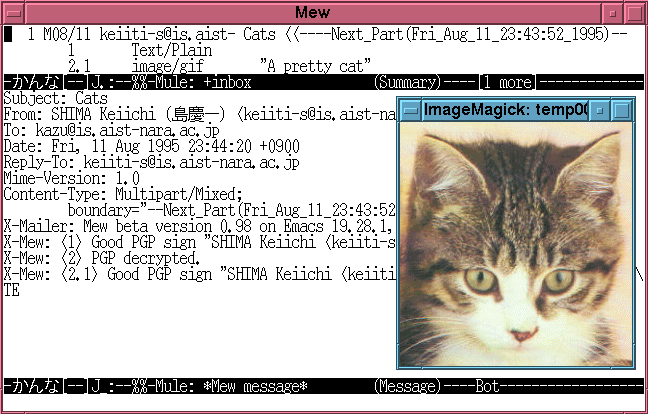
Figure 6 shows an example of a PGP warning corresponding
to Figure 4. The number in angle brackets indicates
the part number. If the number is omitted, the warning is for the entire
message. The first line tells us that part 1 is signed by "Keiiti"
whose public key's validity is complete and that the verification
succeeded. The second line shows that part 2 was encrypted multipart.
Part 2.1 contains a good signature by Keiiti. Figure 7
gives a snapshot image of the PGP/MIME viewer displaying the message of
Figure 4. The GIF image of a cat, which is signed by
Keiiti, is displayed by an image viewer.
If the public key of an originator is not found in the recipient's
keyring or the keyring itself does not exist, signature verification
fails. If a PGP/MIME message is not encrypted for the recipient, PGP
cannot decrypt it. Mew reports such causes of PGP decoding failure to
X-Mew: field.
Evaluations and experiences
The syntax of our PGP/MIME is highly dependent on the implementation of
PGP. Since PGP can distinguish whether a PGP object is encrypted,
signed, or signed-then-encrypted by itself, we do not prepare a
parameter to identify the PGP services. Schiller's Internet draft
prepared a new value for the PEM parameter "Content-Domain:" instead
of the MIME parameter "format". This approach is not practical to
PGP/MIME for two reasons. For backward compatibility with PGP, we must
not modify the PGP program at all, so any new parameter or value should
not be defined for PGP. The other reason is that such a PGP parameter is
meaningless for actual implementation. Consider a MIME object containing
a PGP object, which embeds a MIME object. The decoding process is as
follows: After a MIME viewer removes the outer content header, it passes
the content body to PGP to get the inner MIME object, and then it
decodes the inner MIME object. Since PGP does not tell the MIME viewer
whether the embedded object is MIME or text, the MIME viewer cannot
decide the next action for the PGP output. Thus, the MIME viewer must
determine the next action before it executes the PGP subprocess.
An open question is here; "Is application/pgp appropriate for
conventional PGP/MIME messages which are signed by PGP?". Since it is
clear text and MIME viewers treat an object whose subtype of CT: text is
unknown as text/plain, "text/pgp" with charset may be proper. We need
more experience to fix the spec.
Our PGP/MIME composer achieves our design goals. The composer never
defines its composition grammar nor compels users to understand the
syntax of PGP/MIME. In fact, Mew users can create any complicated
PGP/MIME messages with a simple user manual. The file tree mapping to
PGP/MIME syntax is general enough that any other composers on any OS can
easily adopt it.
Our PGP/MIME viewer also achieves our design goals. It stores PGP/MIME
messages in the format in which they were transported. It caches decoded
messages in Emacs buffers so that they can be treated as plain text and
be displayed quickly when they are repeatedly read by users. Since the
viewer displays the structure of messages, users can enjoy rich
operations on any part.
One of the most difficult problems is to forward a PGP/MIME message to a
third person. Since a PGP/MIME message is encrypted for the receiver,
it should be decrypted before forwarding so that the third person can
read it. MIME viewers must see if the message includes any encrypted PGP
objects then it must decrypt PGP objects and reformat the entire message
to obtain a mail-safe form. We believe that a multipart editor can
resolve this problem. Since it has not been implemented yet, we do not
give further explanation here. Currently, Mew users are compelled to
save the decrypted part to a file, then to include the file in a draft
buffer.
Implementation status and availability
Mew now stably runs on Emacs version 18 and 19, Xemacs, and Mule version
1 and 2. Most of Mew is written by Emacs Lisp, and exceeds 11,000 steps.
All features described in this paper have been implemented as well as
many other rich functions. We are planning to enhance warning handling
during composition, especially for validity of public keys. We are also
planning to integrate NetNews to our system. The latest snapshot of Mew
is distributed under GNU Public License 2 and is available from
ftp://ftp.aist-nara.ac.jp/pub/elisp/Mew/mew-current.tar.gz.
Conclusion
This paper described the design and implementation of PGP/MIME. Our
PGP/MIME scheme uses the "CT: application/pgp" to enclose a PGP object
within MIME and provides the "format" parameter to embed not only
localized text but also a MIME object within the PGP object. Those who
can decrypt a specific part are not restricted to the receivers of the
message.
We implemented a novel PGP/MIME interface, "Mew" on Emacs, which is
available as free software. The PGP/MIME viewer of Mew consists of a
local form decoder, a syntax analyzer, and a displayer. When a user
reads a message, the local form decoder recursively decodes according to
CTE:. It also recursively decrypts or verifies PGP objects included in
the MIME message, leaving each PGP warning in a corresponding content
header. The analyzer analyzes the syntax of the locally formatted
message recursively and collects PGP warnings at the same time. Then the
displayer simply displays the syntax in an Emacs buffer so that the user
can select any part and shows PGP warnings in the mail header. Since
decoded messages are cached, the user is never required to enter a
passphrase when reading the message again.
Mew provides two methods for composing PGP/MIME. A shortcut method
targets localized text that is mostly used in daily life. Users can
transform localized text to conventional PGP/MIME with a single key
action. The other method is mark based composing, which allows users to
create complicated PGP/MIME messages intuitively. Users only need to
create a file tree and put marks on each file or directory. Mew converts
the directories to multipart and files to singlepart, walking the file
tree in postorder. Each part is encoded by PGP according to the marks.
Acknowledgements
The author would like to thank anonymous referees for providing valuable
feedback and suggestions. The author is grateful to Atsushi Shionozaki,
Darren Stalder, and David Worenklein for reviewing drafts of this paper.